
About Us
Air Handling Units for Cleanrooms: Ensuring Precise Air Quality and Environmental Control
Nov 05, 2026
Cleanroom environments require more than conventional air conditioning. Industries such as pharmaceuticals, electronics manufacturing, biotechnology, and medical device production depend on carefully controlled indoor conditions to protect sensitive processes and maintain product quality. An Air Handling Unit (AHU) plays a central role in achieving these requirements by regulating air cleanliness, temperature, humidity, and airflow distribution.
IMMERSION ENERGY provides air handling solutions designed to support different industrial and commercial HVAC requirements, including applications where stable environmental conditions and effective air filtration are essential.
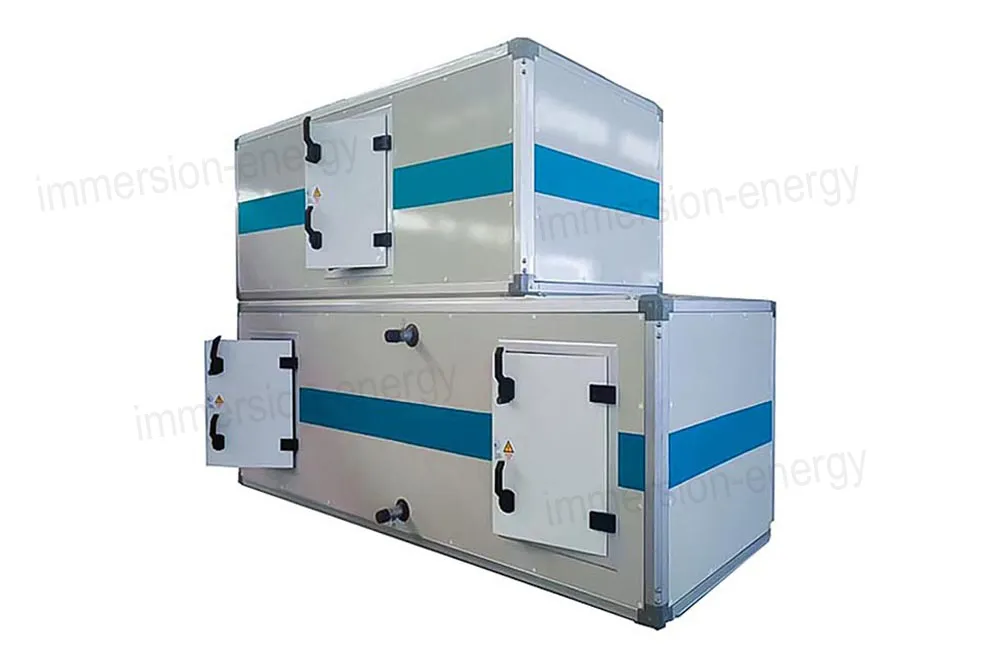
1. What Is a Cleanroom Air Handling Unit?
A cleanroom air handling unit is an HVAC system designed to supply, condition, and distribute treated air within controlled environments. Unlike conventional AHUs, cleanroom configurations place particular emphasis on filtration efficiency, airflow organization, temperature and humidity regulation, and pressure relationships between adjacent rooms.
The system processes outdoor air and, where applicable, recirculated air through a series of treatment stages before delivering it into the cleanroom. Its configuration depends on the required cleanliness classification, process conditions, room layout, and applicable industry standards.
2. Key Functions of an AHU in Cleanroom Applications
(1)High-Efficiency Air Filtration
Air filtration is fundamental to cleanroom operation. AHUs typically incorporate multiple filtration stages, such as pre-filters and intermediate filters, to capture airborne particles and protect downstream components. Depending on the required cleanliness level and system design, terminal HEPA filters may also be installed at the air supply outlets to provide high-efficiency particle removal.
(2)Precise Temperature and Humidity Control
Temperature and relative humidity can directly affect manufacturing processes, equipment performance, and product quality. Cleanroom AHUs integrate heating and cooling coils, humidification or dehumidification equipment, and control systems to maintain the environmental conditions specified for each application.
(3)Controlled Airflow Distribution
Proper airflow organization helps dilute and remove airborne contaminants. Depending on the cleanroom design, systems may use unidirectional or non-unidirectional airflow patterns. Supply air outlets, return air grilles, and duct arrangements must work together to achieve the required air distribution and particle control.
(4)Positive and Negative Pressure Management
Pressure differentials help control the movement of air between cleanrooms and surrounding spaces. Positive pressure is commonly used to prevent less-clean air from entering critical areas, while negative pressure may be required for rooms handling hazardous or potentially contaminating materials. AHU airflow rates must be coordinated with exhaust systems and room sealing to maintain the intended pressure relationships.
3. Typical Applications of Cleanroom AHUs
Cleanroom air handling systems serve a wide range of industries with strict environmental control requirements:
(1)Pharmaceutical Manufacturing: Supports controlled environments for drug production, filling, packaging, and other critical processes.
(2)Electronics and Semiconductor Manufacturing: Helps limit airborne particle contamination that may affect sensitive components and precision manufacturing.
(3)Medical Device Production: Maintains controlled air quality during the manufacturing and assembly of medical equipment.
(4)Biotechnology and Laboratories: Supports stable environmental conditions for research, testing, and specialized production activities.
(5)Healthcare Facilities: Provides controlled ventilation for selected operating rooms, isolation areas, and other specialized medical spaces.
4. Important Considerations When Selecting a Cleanroom AHU
Selecting an appropriate AHU requires a comprehensive understanding of the cleanroom's operational requirements. Key considerations include:
(1)Cleanliness Classification: Determine the required particle concentration limits and applicable standards, such as ISO 14644.
(2)Airflow Requirements: Calculate the necessary supply and exhaust airflow based on room volume, occupancy, process activities, and contamination control strategy.
(3)Filtration Configuration: Select suitable filter grades and terminal filtration arrangements according to the required cleanliness level.
(4)Temperature and Humidity Range: Define the allowable environmental operating limits for the specific production process.
(5)Pressure Differential: Establish appropriate pressure relationships between cleanrooms and adjacent areas.
(6)Control and Monitoring: Consider automated controls and monitoring of temperature, humidity, pressure differential, and filter pressure drop.
A properly engineered AHU should be integrated with the overall cleanroom design rather than selected as an independent piece of equipment. Filter placement, duct design, air balancing, exhaust coordination, and commissioning all influence the final environmental performance.
5. IMMERSION ENERGY: Air Handling Solutions for Controlled Environments
IMMERSION ENERGY focuses on providing HVAC and thermal management equipment for diverse industrial applications. For cleanroom projects, air handling solutions can be configured according to project-specific airflow requirements, filtration arrangements, cooling and heating demands, and control strategies.
From component selection to system configuration, careful engineering coordination helps ensure that the AHU works effectively within the wider ventilation and environmental control system.
A well-designed cleanroom air handling system is an essential part of maintaining consistent air quality and stable operating conditions. By combining appropriate filtration, precise air conditioning, and coordinated airflow management, cleanroom AHUs support reliable production environments across a variety of industries.
Recent Posts


Contact US
Product Information
Quantity
Unit
Piece
Support order samples, customization, wholesale direct, and complete payment. If the product you look for does not have corresponding customized content, pls fill out the form below to contact us, and we will reply ASAP.