
About Us
How CDU Technology Supports Data Center Liquid Cooling
Nov 10, 2026
The rapid development of AI computing, high-performance computing, and high-density server infrastructure is driving greater demand for efficient data center cooling technologies. As rack power density continues to increase, traditional air cooling systems face challenges in removing concentrated heat from advanced computing equipment. Coolant Distribution Units have therefore become an essential component of modern liquid cooling infrastructure.
IMMERSION ENERGY presents 800 kW CDU solution designed for data center liquid cooling applications in India, supporting efficient heat exchange, controlled coolant circulation, and reliable thermal management for high-density computing environments.
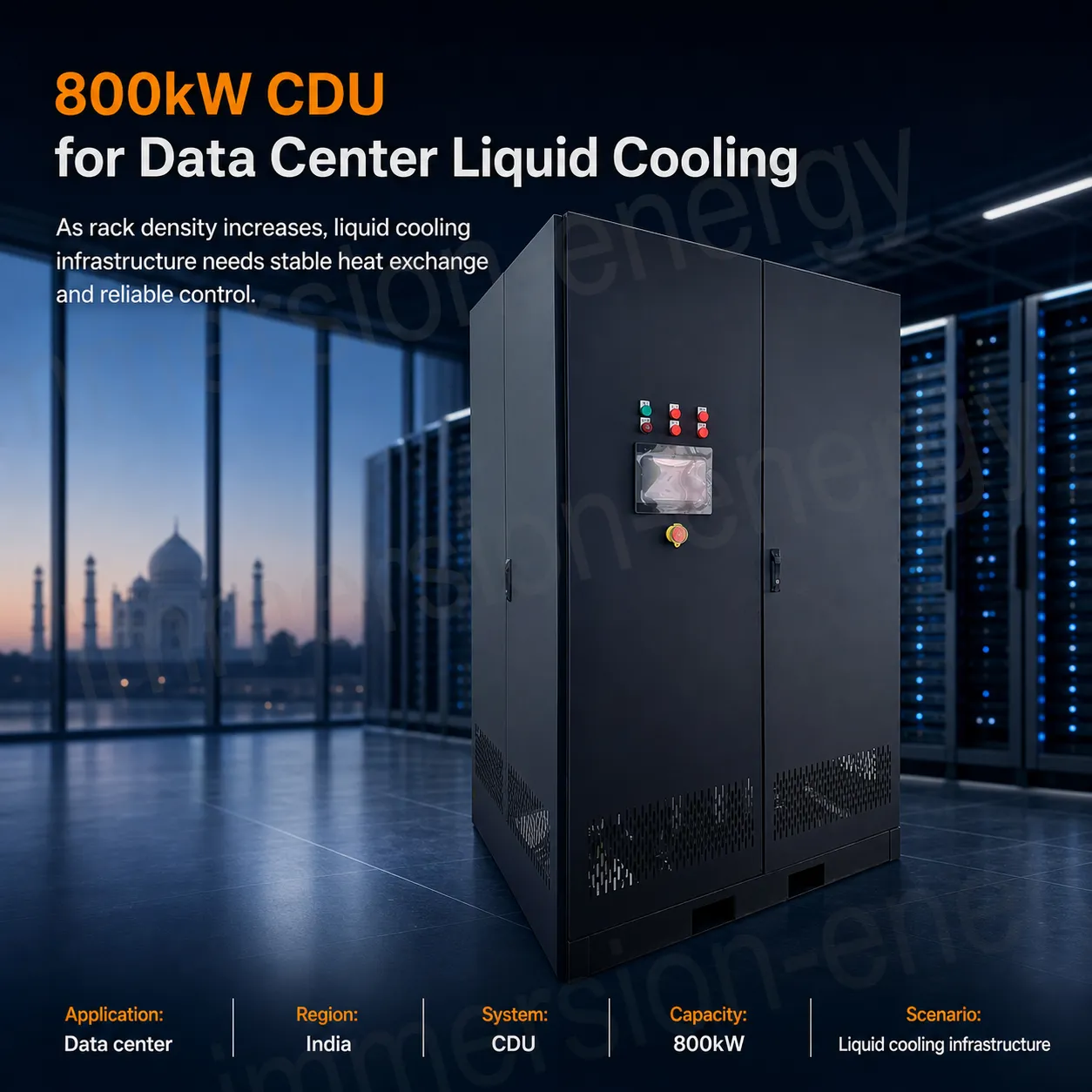
What Is a Coolant Distribution Unit ?
A Coolant Distribution Unit is a key component in a liquid cooling system that manages the circulation and heat transfer of coolant between the facility cooling infrastructure and IT equipment.
In a typical liquid cooling configuration, the CDU connects the primary cooling loop to the secondary cooling loop through a heat exchanger. The primary loop transfers heat toward the facility cooling system, while the secondary loop circulates coolant to directly cooled IT equipment, such as liquid-cooled servers.
By separating the two cooling circuits, the CDU helps maintain appropriate coolant conditions and supports stable operation of the liquid cooling infrastructure.
Key Functions of a CDU in Data Centers
1. Efficient Heat Exchange
The CDU transfers heat from the IT equipment cooling loop to the facility water loop through a heat exchanger. This process helps remove heat generated by high-performance servers and supports continuous cooling operation.
2. Coolant Circulation and Distribution
Integrated circulation pumps help maintain the required coolant flow throughout the secondary loop. Proper coolant distribution is essential for delivering consistent cooling performance to liquid-cooled server racks.
3. Temperature and Pressure Management
A CDU can incorporate sensors, control valves, and intelligent control systems to monitor operating conditions and regulate coolant circulation. These functions help maintain stable temperature and pressure conditions within the liquid cooling system.
4. System Protection and Operational Reliability
Depending on its configuration, a CDU may integrate filtration, leakage detection, alarm functions, and protective controls. These features help improve operational safety and support the continuous operation of critical data center infrastructure.
Why Is CDU Capacity Important for High-Density Computing?
As AI workloads and computing density increase, the heat generated within server racks also rises. Cooling infrastructure must therefore accommodate higher thermal loads while maintaining stable operating conditions.
An 800 kW CDU provides a substantial heat transfer capacity for large-scale liquid cooling applications. Proper capacity selection should consider the total IT heat load, coolant flow rate, supply and return temperatures, system pressure requirements, and future expansion plans.
The integration of appropriately sized CDUs helps data center operators build scalable liquid cooling infrastructure and support the thermal requirements of next-generation computing facilities.
IMMERSION ENERGY: Supporting Next-Generation Data Center Cooling
IMMERSION ENERGY focuses on thermal management solutions for data centers and industrial cooling applications. Its 800 kW CDU solution for the Indian market reflects the growing demand for high-capacity liquid cooling infrastructure.
By supporting coolant circulation, heat exchange, and system monitoring, CDU technology plays an important role in managing the increasing thermal demands of modern data centers.
As AI and high-performance computing continue to evolve, IMMERSION ENERGY remains committed to providing reliable and adaptable cooling solutions that support the development of next-generation data center infrastructure.
Recent Posts

Contact US
Product Information
Quantity
Unit
Piece
Support order samples, customization, wholesale direct, and complete payment. If the product you look for does not have corresponding customized content, pls fill out the form below to contact us, and we will reply ASAP.