
About Us
Container Liquid Cooling Data Centers: Technology, Working Principles and Key Advantages
Nov 02, 2026
The rapid development of AI, high-performance computing , and cloud infrastructure is transforming the way modern data centers are designed. As computing power increases, server racks generate higher heat loads, creating new challenges for conventional air cooling systems. Container liquid cooling data centers offer an integrated approach to addressing these challenges through modular infrastructure and advanced thermal management technologies.
IMMERSION ENERGY focuses on integrated cooling solutions and modular data center infrastructure, providing application-oriented solutions for high-density computing environments and evolving data center requirements.
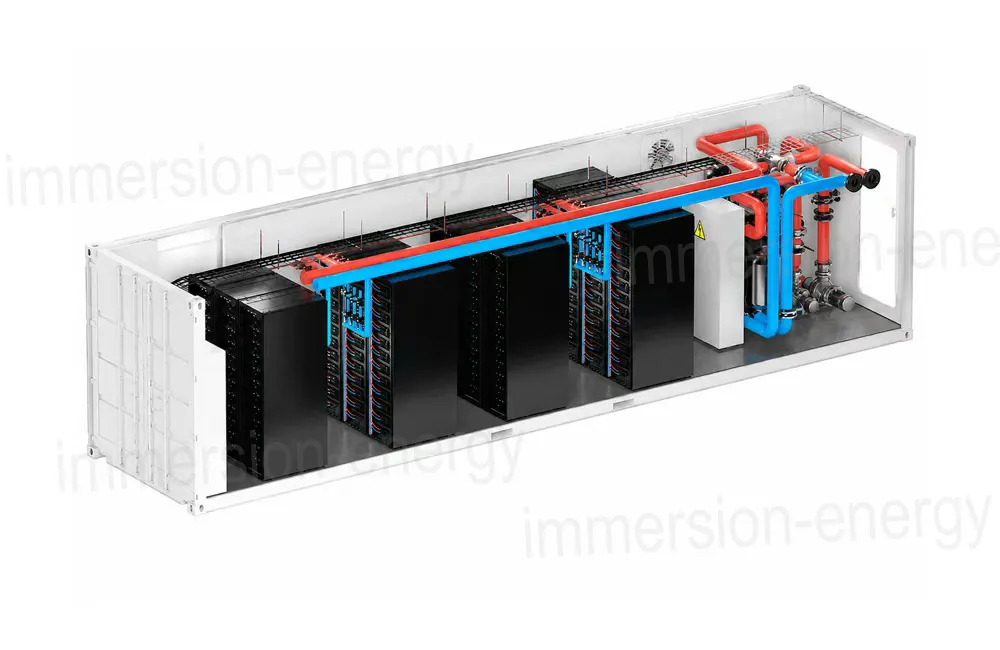
1. What Is a Container Liquid Cooling Data Center?
A container liquid cooling data center is a prefabricated, modular computing facility that integrates IT infrastructure, power distribution, cooling systems, and supporting equipment within a containerized enclosure.
Unlike conventional data centers that rely primarily on building-based infrastructure, containerized solutions are designed for flexible deployment and integrated system configuration. Liquid cooling technology is incorporated to remove heat generated by high-density servers more effectively.
Depending on the project requirements, liquid cooling configurations may include direct-to-chip cooling, rear-door heat exchangers, or other liquid-based thermal management technologies. These solutions can be combined with supporting cooling equipment to create a coordinated thermal management system.
2. How Does a Liquid Cooling System Work?
Liquid cooling transfers heat through a circulating coolant rather than relying entirely on air movement. The general process involves three main stages:
Heat Collection: Coolant circulates through cold plates, heat exchangers, or other cooling interfaces to absorb heat from servers and IT components.
Heat Transfer: Heated coolant flows through the liquid distribution system to a Cooling Distribution Unit (CDU), where heat is transferred to a secondary cooling circuit through a heat exchanger.
Heat Rejection: The secondary circuit carries the collected heat to external heat rejection equipment, such as dry coolers, chillers, or cooling towers, depending on the system design.
This arrangement separates the IT-side cooling circuit from the facility-side cooling infrastructure, allowing temperature, flow rate, and operating conditions to be managed according to specific application requirements.
3. Advantages of Container Liquid Cooling Data Centers
(1)High-Density Computing Support: Liquid cooling provides an effective method of removing heat from high-power server components, supporting demanding AI and HPC workloads.
(2)Modular Deployment: Prefabricated container structures allow infrastructure to be configured and deployed according to project requirements.
(3)Integrated System Design: Cooling, power, monitoring, and IT infrastructure can be coordinated within a unified modular architecture.
(4)Flexible Scalability: Additional modules can be considered as computing capacity expands, subject to site conditions and infrastructure planning.
(5)Optimized Thermal Management: Liquid-based heat transfer can improve cooling efficiency for high-density equipment, depending on operating conditions and overall system design.
4. IMMERSION ENERGY: Integrated Cooling for Next-Generation Data Centers
The development of high-density computing infrastructure requires more than individual cooling equipment. It calls for coordinated engineering across thermal management, power distribution, monitoring, and modular infrastructure.
IMMERSION ENERGY focuses on integrated data center cooling solutions and modular infrastructure, combining equipment engineering with project-oriented system integration. From liquid cooling equipment and CDUs to dry coolers and other supporting thermal management systems, solutions can be configured according to project scope and technical requirements.
As AI and high-performance computing continue to reshape the data center industry, IMMERSION ENERGY remains committed to supporting customers with flexible infrastructure configurations and reliable cooling technologies for next-generation computing environments.

Recent Posts

Contact US
Product Information
Quantity
Unit
Piece
Support order samples, customization, wholesale direct, and complete payment. If the product you look for does not have corresponding customized content, pls fill out the form below to contact us, and we will reply ASAP.