
About Us
Beyond Heat Removal: How Dry Coolers Improve Cooling System Efficiency
Oct 23, 2026
Introduction
In modern data centers and industrial facilities, effective heat rejection is not simply about removing excess heat. It is about maintaining stable operating conditions while managing energy consumption, water usage, and long-term maintenance requirements. As computing workloads increase and industrial processes become more demanding, dry coolers offer a practical approach to improving thermal management through air-based heat exchange.
IMMERSION ENERGY provides dry cooler solutions designed for a variety of cooling requirements, including data centers, immersion cooling systems, power generation, and industrial process cooling. With customizable configurations and multiple product designs, these systems can be adapted to different cooling media, operating conditions, and project specifications.
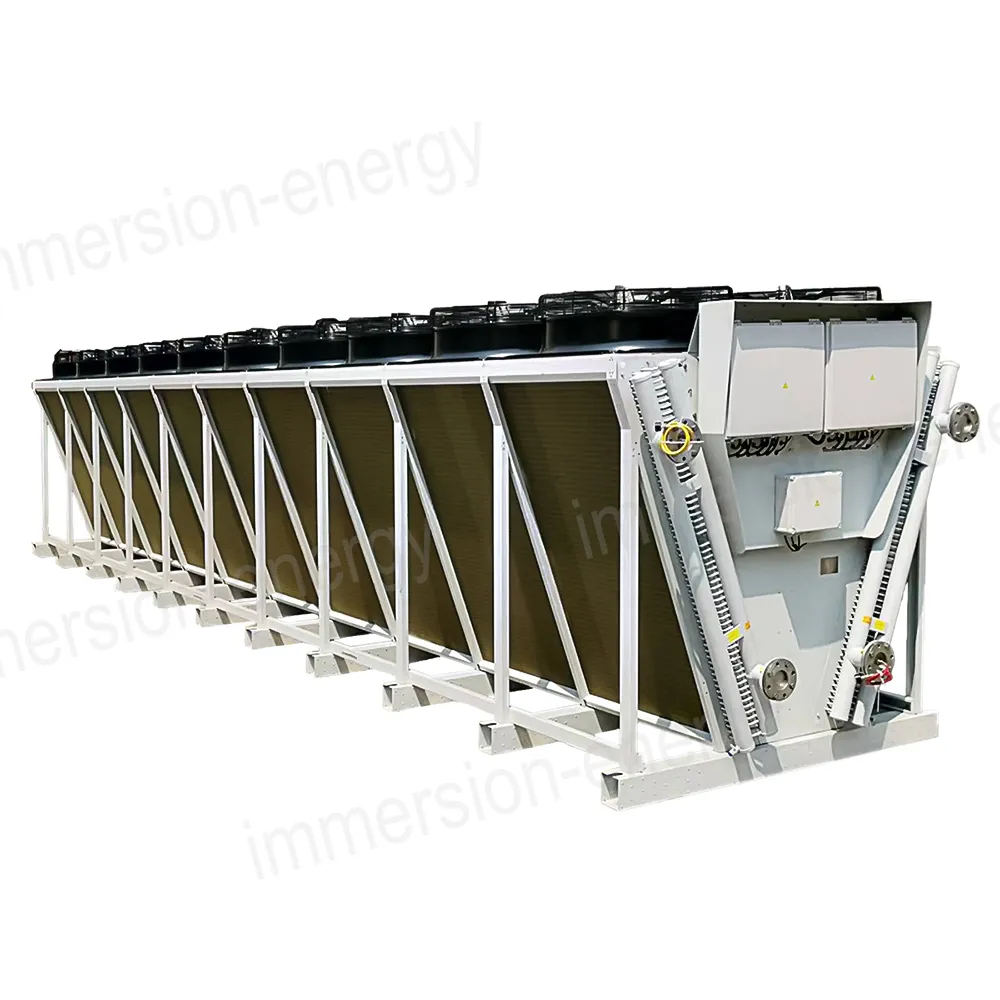
How Does a Dry Cooler Work?
A dry cooler transfers heat from a circulating fluid, such as water or glycol-based coolant, to the surrounding air through a heat exchanger. Fans move ambient air across the heat exchanger surface, allowing the fluid to release heat without relying on direct evaporative cooling as the primary heat transfer process.
Unlike conventional cooling towers, standard dry coolers do not require continuous evaporation of water to reject heat. This can reduce water consumption and simplify water treatment requirements, making dry coolers an attractive option for facilities seeking more efficient resource management.
Their actual cooling performance depends on factors such as ambient temperature, fluid properties, heat exchanger design, airflow, and operating load. Selecting the right configuration is therefore essential to achieving the desired cooling performance.
Key Advantages of IMMERSION ENERGY Dry Coolers
1. Flexible Configurations for Different Applications
Different facilities have different thermal management requirements. IMMERSION ENERGY offers multiple dry cooler designs, including D-series units, V-shaped configurations, and immersion cooling dry coolers. Depending on the project, heat exchanger materials, fin spacing, fan arrangements, and casing options can be selected to suit specific operating conditions.
2. Efficient Heat Rejection
Heat exchanger design and fan performance play important roles in overall cooling efficiency. Properly selected heat exchange surfaces and airflow configurations help transfer heat effectively while managing fan power consumption. Under favorable outdoor conditions, dry coolers can also support free-cooling strategies and reduce the operating hours of mechanical refrigeration equipment when the overall system is designed accordingly.
3. Reduced Water Consumption
Because standard dry coolers reject heat primarily through air-based heat exchange, they can substantially reduce water consumption compared with evaporative cooling systems. For facilities operating in water-constrained regions, this can be an important consideration in long-term infrastructure planning.
For applications requiring additional cooling capacity during high ambient temperatures, adiabatic dry cooler configurations can pre-cool incoming air using water. This approach can enhance heat rejection under suitable conditions, although water consumption will depend on the operating mode and environmental conditions.
4. Adaptability to Specialized Cooling Media
Cooling requirements vary across applications. IMMERSION ENERGY dry coolers can be configured for compatible fluids such as water, glycol solutions, oil, and specialized dielectric fluids used in immersion cooling systems. Material selection, fluid compatibility, and operating parameters must be evaluated for each project to support reliable long-term operation.
Applications Across Multiple Industries
IMMERSION ENERGY dry coolers can support heat rejection in data centers, high-density computing environments, immersion cooling systems, power generation facilities, and industrial processes. For data centers, they can form part of a broader cooling architecture. In immersion cooling applications, they help remove heat transferred from dielectric fluid through the associated heat exchange system. In industrial facilities, they provide an air-based option for cooling compatible circulating fluids.
Conclusion
Choosing a dry cooler involves more than comparing nominal cooling capacities. Heat load, ambient conditions, cooling medium, water availability, energy consumption, and maintenance requirements should all be considered during system design.
IMMERSION ENERGY develops customizable dry cooler solutions to address diverse thermal management challenges across data center and industrial applications. If you are looking for a dry cooler tailored to your project requirements, please feel free to contact IMMERSION ENERGY for further information and professional support.
Recent Posts

October 26, 2016
The Most Successful Engineering Contractor
Oct 14, 2026
How Air Cooled Heat Exchangers Work in Oil and Gas
Contact US
Product Information
Quantity
Unit
Piece
Support order samples, customization, wholesale direct, and complete payment. If the product you look for does not have corresponding customized content, pls fill out the form below to contact us, and we will reply ASAP.