
About Us
Container Data Centers for AI and High-Density Computing
Oct 20, 2026
As AI, cloud computing, and high-performance computing continue to expand, data center operators face growing challenges in thermal management, infrastructure coordination, and deployment flexibility. Container data centers provide a modular approach to building computing infrastructure by integrating IT equipment and essential supporting systems within prefabricated enclosures. This approach can help simplify project implementation and accommodate evolving capacity requirements.
IMMERSION ENERGY focuses on cooling solutions for demanding industrial and computing applications, supporting container data center projects with cooling equipment and thermal management solutions tailored to specific project requirements.
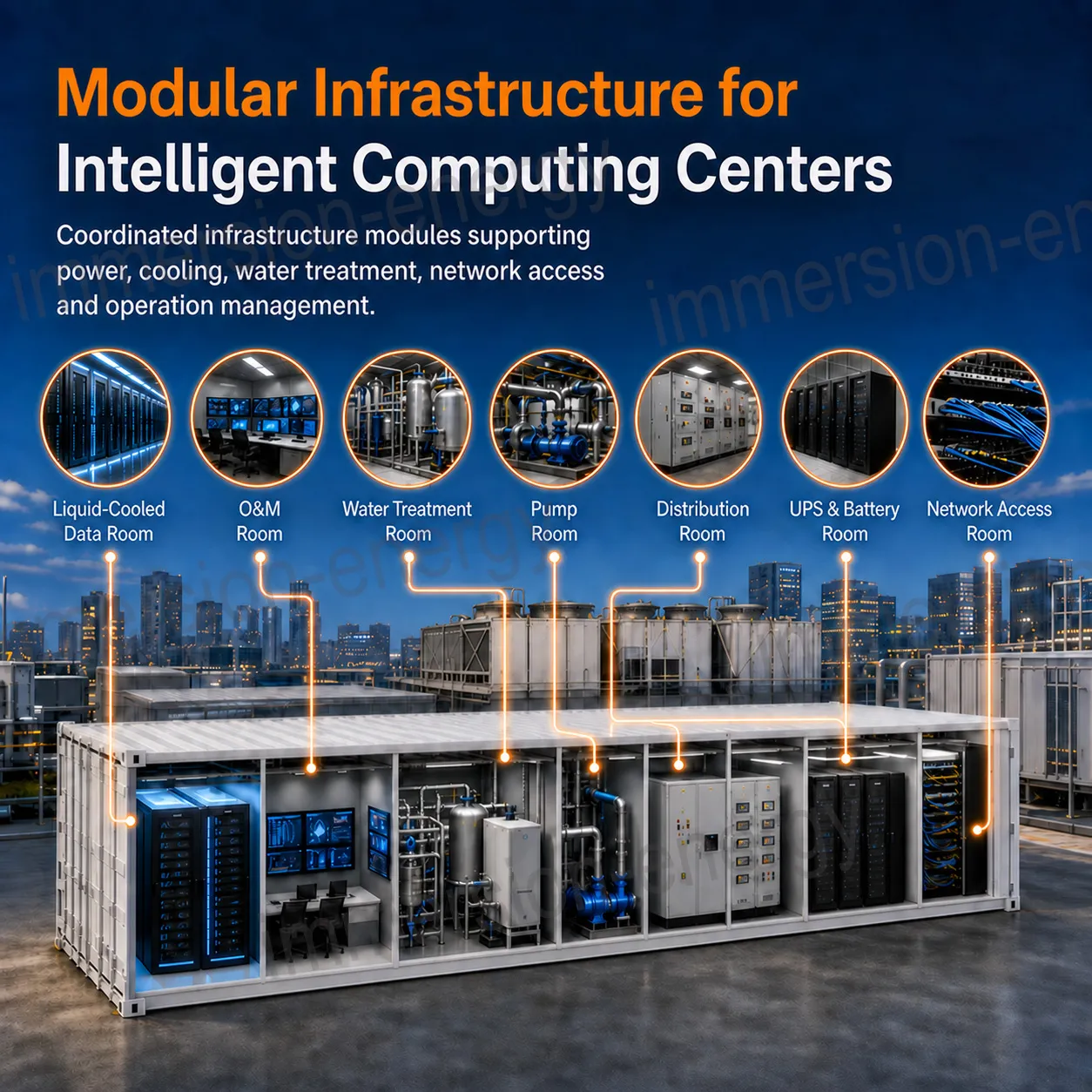
Integrated Infrastructure for Modular Deployment
A container data center is more than a prefabricated enclosure for server racks. Its performance depends on the coordinated design of computing equipment, power infrastructure, cooling systems, network connectivity, and facility controls.
For large-scale projects, these systems must be planned together to ensure compatibility, operational reliability, and efficient use of available space. A well-coordinated modular design can simplify installation planning, reduce on-site integration complexity, and provide a structured foundation for future expansion.
The specific configuration depends on IT capacity, site conditions, operating requirements, and the project's infrastructure design.
Thermal Management for High-Density Computing
AI servers and high-performance computing systems generate substantial heat, particularly as rack power density increases. Effective heat removal is therefore essential to maintaining stable operating conditions and supporting the long-term reliability of data center infrastructure.
IMMERSION ENERGY emphasizes the importance of matching cooling equipment and system configuration to the actual thermal load. Depending on project requirements, suitable solutions may incorporate dry coolers, chillers, CDUs, and compatible liquid cooling systems.
Dry coolers can transfer heat from circulating fluid to ambient air, while chillers provide active cooling when required by the system design. For liquid-cooled computing environments, CDUs help manage coolant circulation and heat exchange between the facility cooling system and the IT equipment cooling loop.
The selection and combination of these technologies depend on cooling capacity, fluid temperatures, ambient conditions, energy performance targets, and system redundancy requirements. Coordinated engineering is essential to ensure that the cooling solution is compatible with the overall data center architecture.
Key Benefits for Large-Scale Projects
1.Modular Deployment
Prefabricated container designs can reduce the amount of on-site construction and help coordinate installation across different infrastructure systems. Actual deployment schedules depend on site preparation, project complexity, and commissioning requirements.
2.Scalable Infrastructure Planning
Modular configurations allow capacity to be planned around phased deployment needs. Future expansion can be considered from the outset, subject to available power, cooling capacity, space, and network infrastructure.
3.Coordinated Cooling System Integration
Integrating cooling equipment into the wider infrastructure design helps align heat rejection capacity, fluid circulation, control requirements, and IT deployment plans. This is particularly important for high-density computing environments with demanding thermal loads.
4.Adaptability to Different Applications
Container data centers can support AI computing, cloud services, edge computing, and other specialized applications. Cooling equipment and environmental protection measures should be selected according to the project's operating conditions and technical requirements.
IMMERSION ENERGY: Cooling Solutions for Evolving Data Center Needs
For data center developers, EPC contractors, and enterprise operators, successful modular deployment requires careful coordination between IT equipment, electrical infrastructure, cooling systems, and long-term maintenance planning.
IMMERSION ENERGY supports data center projects with cooling equipment and thermal management solutions designed around specific application requirements. By focusing on heat rejection, liquid cooling interfaces, and cooling system integration, the company helps customers address the thermal challenges associated with high-density computing and evolving AI infrastructure.
As computing demand continues to grow, container data centers offer a flexible approach to deploying and expanding digital infrastructure. With appropriate engineering and coordinated cooling design, modular facilities can provide a practical foundation for reliable operations and future capacity development.
Recent Posts

October 26, 2016
The Most Successful Engineering Contractor
Oct 14, 2026
How Air Cooled Heat Exchangers Work in Oil and Gas
Contact US
Product Information
Quantity
Unit
Piece
Support order samples, customization, wholesale direct, and complete payment. If the product you look for does not have corresponding customized content, pls fill out the form below to contact us, and we will reply ASAP.