
About Us
CDUs for High-Density Data Center Liquid Cooling
Oct 28, 2026
As artificial intelligence , high-performance computing , and other compute-intensive applications continue to evolve, data centers face increasing thermal management challenges. Higher rack power densities place greater demands on cooling infrastructure, making efficient heat transfer, precise coolant distribution, and reliable system control essential. IMMERSION ENERGY provides liquid cooling solutions designed to support the evolving thermal management requirements of modern data centers.
What Is a Coolant Distribution Unit ?
A Coolant Distribution Unit is a key component in liquid cooling infrastructure. It manages the circulation and distribution of coolant between the facility cooling system and IT equipment, while facilitating heat transfer between the primary and secondary coolant loops in liquid-to-liquid configurations.
By maintaining appropriate coolant flow and operating conditions, a CDU helps remove heat generated by high-density computing equipment. Depending on the system design, it can integrate heat exchangers, pumps, valves, sensors, filtration components, and intelligent control systems to support stable operation and effective thermal management.
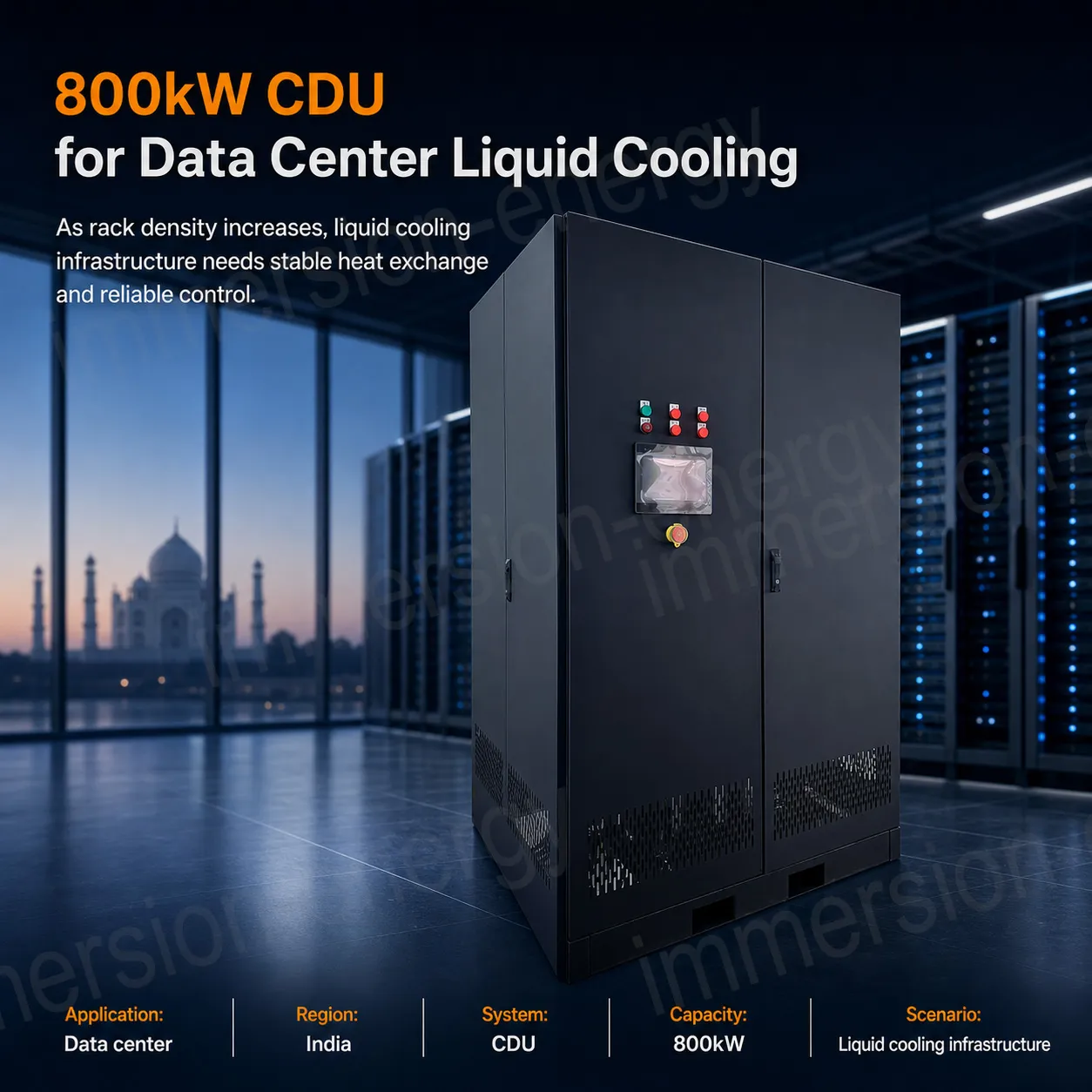
Supporting High-Capacity Cooling Requirements
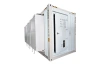
The 800kW CDU featured here is designed for data center liquid cooling applications that require substantial heat transfer capacity. It represents an approach to supporting demanding cooling loads through integrated equipment design and coordinated system control.
Key considerations for high-capacity CDU applications include:
1.Heat exchange performance: Efficient heat transfer between coolant loops helps manage the thermal load generated by IT equipment.
2.Coolant circulation: Properly selected pumps and hydraulic components support the required flow rate and system pressure.
3.Monitoring and control: Sensors and control systems help monitor operating parameters and maintain appropriate cooling conditions.
4.System integration: Compatibility with facility-side cooling equipment and rack-level liquid cooling infrastructure supports coordinated operation.
5.Operational reliability: Appropriate component selection, protection measures, and maintenance accessibility contribute to long-term system performance.
The actual configuration and operating parameters should be selected according to the cooling load, coolant properties, inlet and outlet temperatures, flow requirements, and site conditions.
The Role of CDUs in Modern Data Centers
As liquid cooling becomes increasingly important for high-density computing, CDUs serve as a critical interface between heat-generating IT equipment and the wider cooling infrastructure. Effective coolant management helps maintain suitable operating conditions for computing hardware and supports the deployment of higher-density racks.
For large-scale data centers, selecting a CDU involves more than evaluating nominal cooling capacity. Engineers must also consider hydraulic performance, heat exchanger design, control requirements, maintenance provisions, and compatibility with the overall cooling architecture.
IMMERSION ENERGY: Liquid Cooling for Evolving Computing Needs
IMMERSION ENERGY focuses on thermal management solutions for demanding computing environments. By addressing heat transfer, coolant circulation, and system integration, its liquid cooling offering supports the infrastructure requirements of modern data centers and high-density computing applications.
Recent Posts

October 26, 2016
The Most Successful Engineering Contractor
Oct 14, 2026
How Air Cooled Heat Exchangers Work in Oil and GasContact US
Product Information
Quantity
Unit
Piece
Support order samples, customization, wholesale direct, and complete payment. If the product you look for does not have corresponding customized content, pls fill out the form below to contact us, and we will reply ASAP.